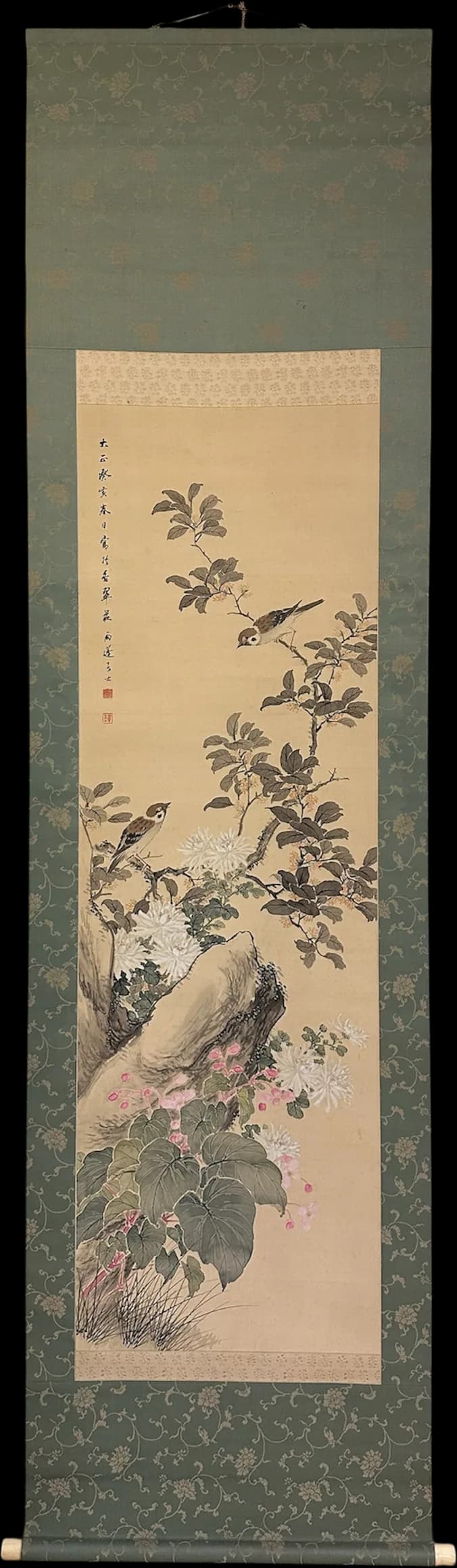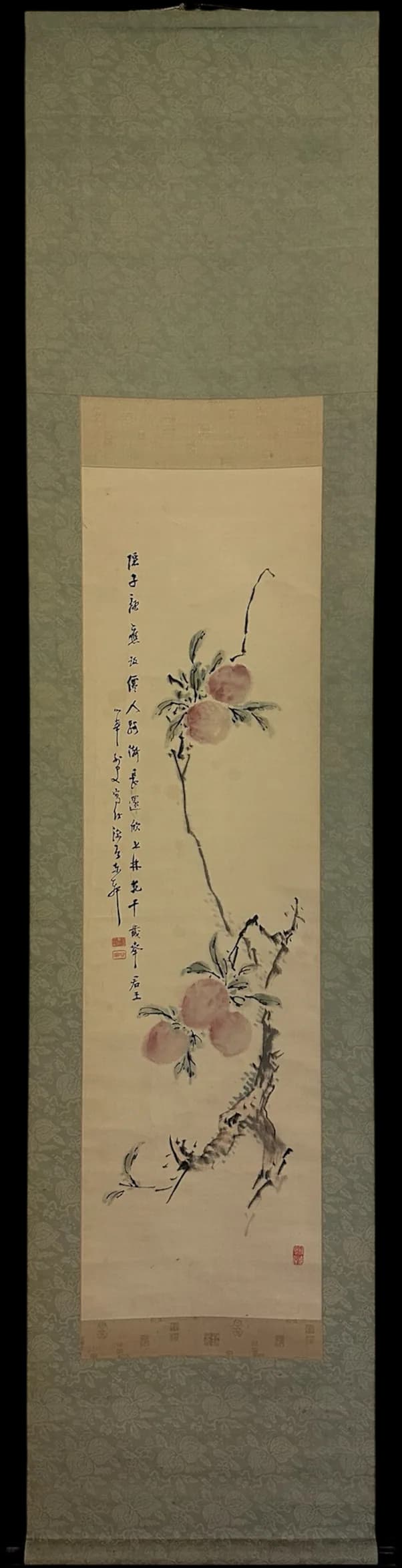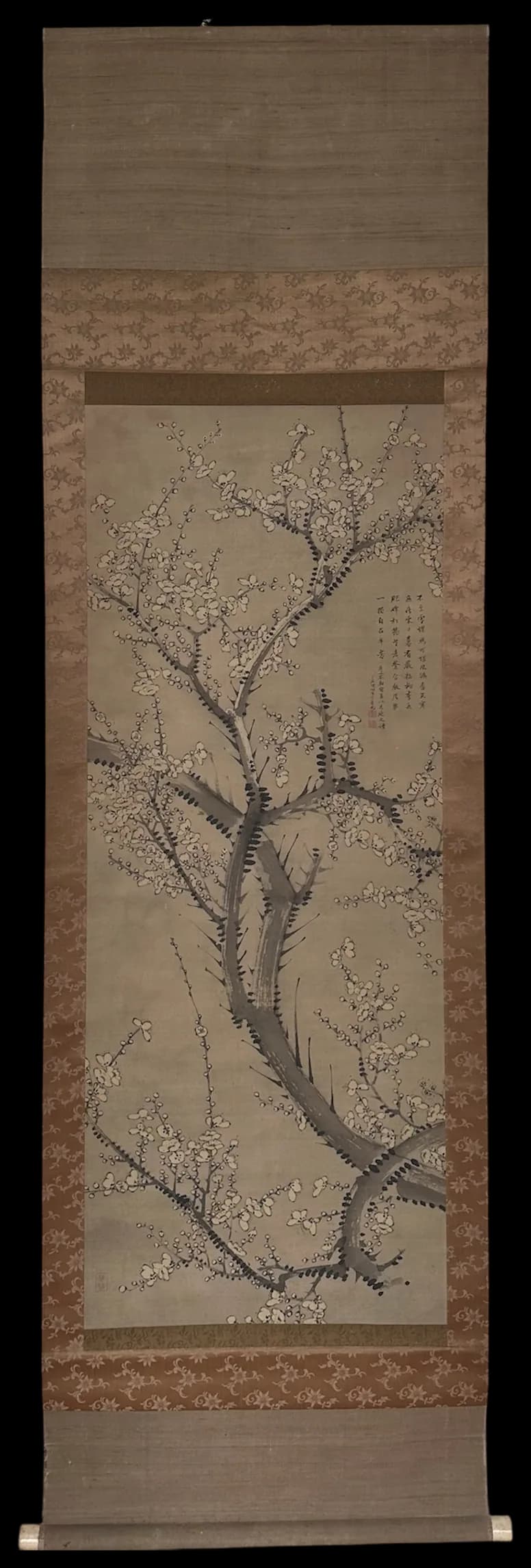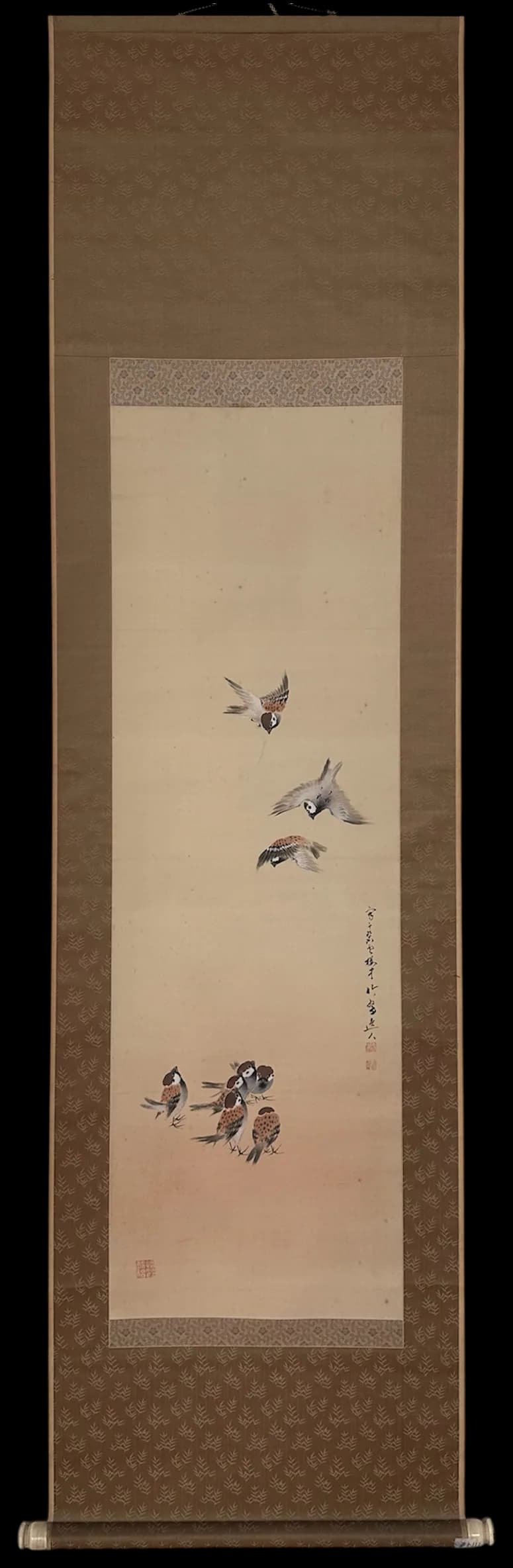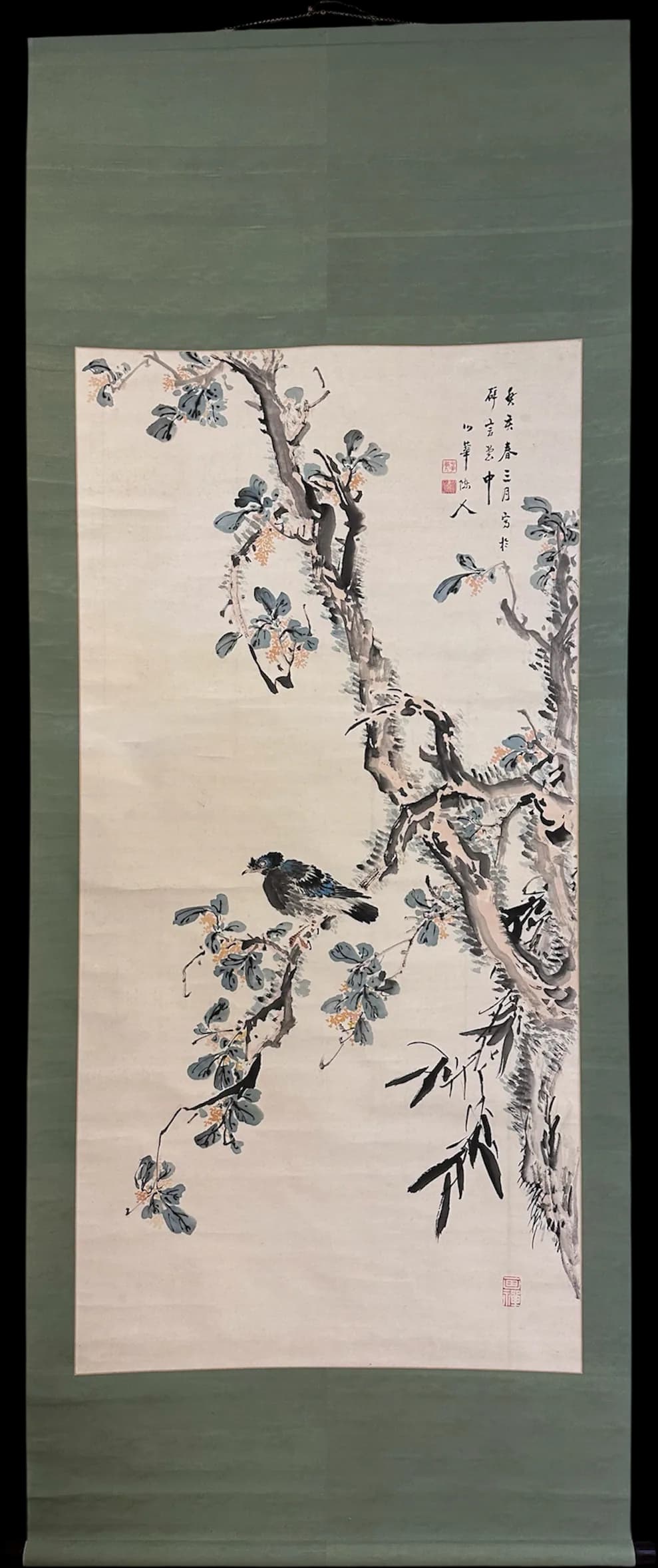
The whole scroll 1 of 12
Shirasu Shinka (1870–1939)
白須心華
Birds and Flowers
叭々鳥図
- Period
- Kindai (近代) · Taishō period
- Date
- 1923
- Subject
- Birds and Flowers (花鳥)
- Medium
- Hanging scroll; ink and color on paper
Description
Shirasu Shinka was a prominent modern Nanga painter of the Tanomura lineage. The fourth son of Confucian scholar Shirasu Goen 白須梧園, he initially pursued a career in the Imperial Japanese Navy, serving on the Navy General Staff during the First Sino-Japanese War and Russo-Japanese War before retiring in 1908 to devote himself fully to painting. He had joined the Shinbikai 真美会 painting society in 1905, and in 1906, he opened his own painting academy in Tokyo. He spent his last years in Beppu, Kyūshū, where he dedicated himself to the flourishing Bungo Nanga 豊後南画 tradition pioneered by Tanomura Chikuden.
bird-and-flower paintings in color almost always strive for bright, vivid hues, in the hope of conveying good fortune and prosperity. Shinka, however, takes the opposite approach here. Indigo and pale ochre set the tone throughout, with orange-yellow dabbed only into the blossoms. The palette is refined and controlled, closely resembling the senkō 淺絳 (light ochre and indigo) manner of landscape painting. Set against the splashed ink of the branches and the scorched ink of the bamboo leaves, it reveals the real strength of brushwork beneath a mood of quiet ease.
The myna sits hunched on its branch, its gaze fixed and still, neither looking about nor calling out. Mynas are noisy, gregarious birds, yet this one keeps to a branch of its own, quiet and self-contained, as if deliberately removed from the clamor of the world. This reclusion echoes the inscription. The studio name Hekigendō 辟言堂 comes from the Analects: 賢者辟世/其次辟地/其次辟色/其次辟言 “The worthiest withdraw from the world; the next, from a particular land; the next, from a hostile look; the next, from hostile words.” To “shun words” is to walk away when others speak with malice or insolence. His signature, chinjin 陳人, borrows a term from the Zhuangzi, a self-deprecating name for an outmoded, useless man. Taken together, the two names describe someone who not only steps away from wrangling but places himself outside the currents of his time. He painted this work in 1923, fifteen years after leaving the navy to devote himself to painting, and between the studio name and the signature, one senses a man who had turned from official life to keep faith with himself through his art. The hushed bird on its solitary branch is thus less a decorative motif than an emblem for Shinka himself, holding its peace amid the clamor.
One step beyond escaping the clamor lies the transcendence of words themselves. The seal gazen 畫禪, “Painting as Zen,” at lower right calls to mind the Zen principle of non-reliance on words and letters, for true meaning lies beyond speech. In Japan, the myna has been a subject of Zen-inflected ink painting since the Muromachi period, and this silent bird stands in quiet accord with that principle. Seen in this light, the painting’s restraint and stillness are at once a portrait of Shinka’s self-possession and, perhaps, a wordless confession of Zen practiced with the brush.
Painting inscription
癸亥春三月寫於辟言堂中 心華陳人 (Painted in March of spring in the mizunotoi year [1923] at the Studio of Shunning Speech—Shinka, a mediocre man)
Seals
(rectangular relief seal) Shinka dōjin 心華道人; (rectangular intaglio seal) Kōshuku fu 公肅父; (rectangular intaglio seal) gazen 画禪